Practical Uses of AI for Small Businesses in 2026
Sixty-eight percent of small businesses now use AI regularly. That is up from 48% just two years earlier, and it means AI adoption has moved past the early-adopter phase.[1] Among businesses with 10 to 100 employees, usage jumped from 47% to 68% in a single year.[1] For small business owners who have not touched AI yet, the question is no longer whether it is worth exploring. It is where to start.
The good news is that practical AI uses for small businesses do not require a technical team or a big budget. Most of the gains are coming from a handful of everyday tasks: writing, customer response, scheduling, and pricing. The average small business now uses a median of five AI tools across its operations, and 82% of small business employers use at least one.[2] That is a wide range of entry points, and most owners start with just one or two before adding more.
The businesses seeing the best results are also the ones paying attention to a second, less visible part of the equation: how to use these tools without exposing sensitive data in the process. Both halves of that equation matter, and skipping the second one is where a lot of small businesses run into trouble later.
Practical AI Uses for Small Businesses Right Now
Writing and marketing content is the single most common AI use case among small businesses, cited by 83% of companies already using AI in some form.[4] That tracks with what many owners experience firsthand: drafting newsletters, product descriptions, or social posts used to eat hours out of the week, and AI tools have made a real dent in that time.
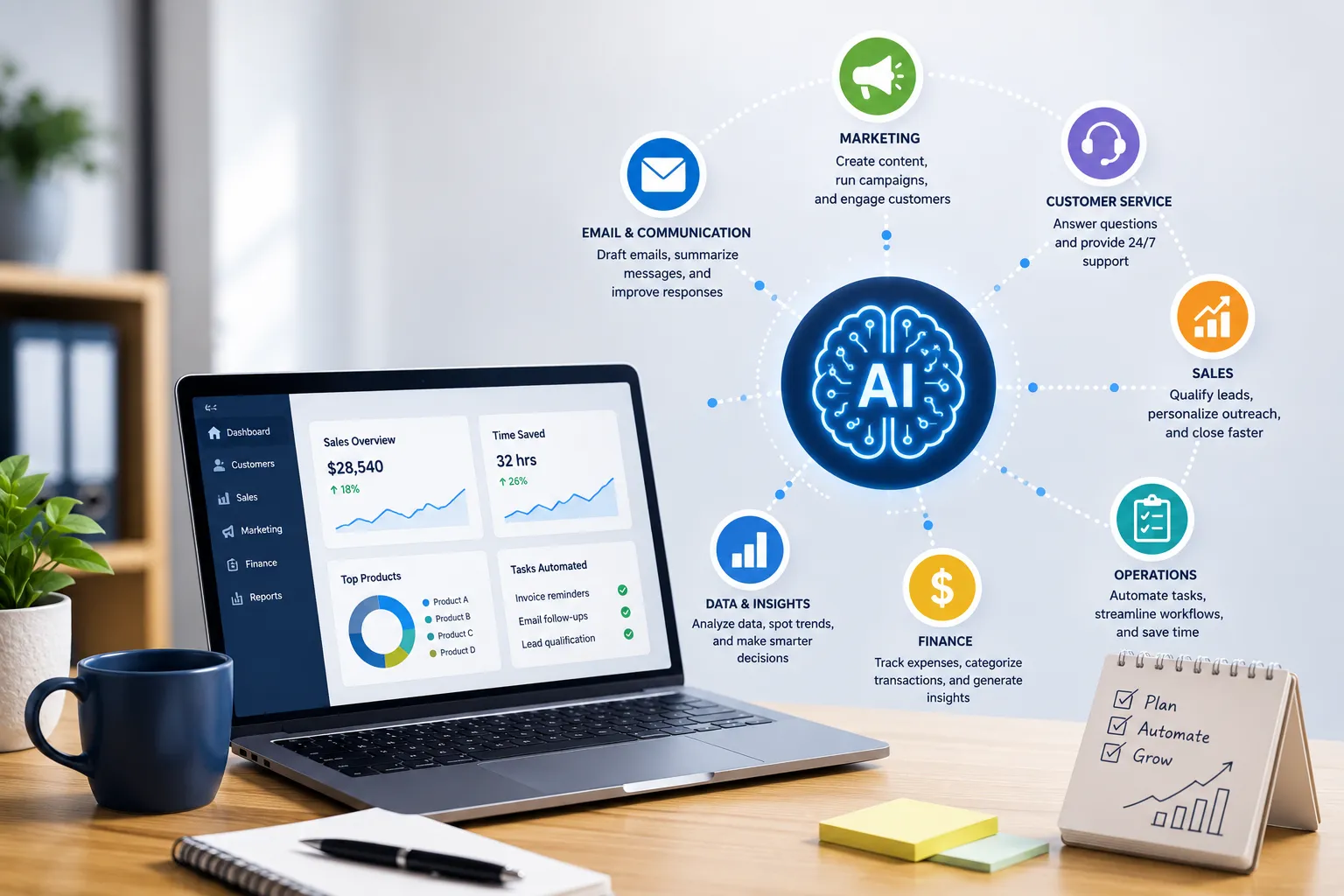
Marketing and Content
Fifty-four percent of small businesses already use AI marketing tools, and another 27% plan to adopt one within the next year.[3] That makes marketing the fastest and most common entry point into AI for small teams. It is low-risk work to hand off first: a draft blog post, an email subject line, or a first pass at ad copy can be reviewed and edited by a person before anything goes out.
Customer Service
Customer service is close behind. Forty-six percent of small businesses now use AI-powered chatbots or automated response tools to handle routine questions.[3] These tools are not replacing staff so much as filtering the easy questions, like store hours or order status, so employees can spend their time on the calls and messages that actually need a person.
For a small business with no after-hours staff, this can be the difference between capturing a lead who reaches out at 9 p.m. and losing them to whichever competitor answers first. It also reduces the number of small interruptions that pull an owner or office manager away from other work throughout the day.
Cutting Busywork: Scheduling, Admin, and Data Entry
Beyond marketing and customer service, a growing set of tools now handle appointment scheduling, invoice processing, social media posting, and lead qualification.[6] Individual productivity tasks, things like summarizing documents or drafting internal notes, are the second most common AI use case, reported by 61% of businesses using AI.[4] Planning and analysis work follows at 51%.[4]
None of this is glamorous, but it is exactly the kind of work that piles up in a small business without a dedicated admin team. A scheduling assistant that confirms appointments automatically, or a tool that pulls key details out of an invoice, gives an owner or office manager back hours every week that used to go into repetitive data entry.
The appeal here is less about doing something new and more about doing something familiar faster. Nobody starts a business because they want to spend Friday afternoon reconciling invoices, and this is the category of AI use where the time savings tend to be the most immediately noticeable.
Smarter Pricing and Decision-Making
Pricing is a newer but fast-growing use case. Sixty-five percent of small businesses are either using AI pricing tools already or plan to implement one soon.[2] Among businesses that have adopted these tools, the results stand out: 97% report a positive impact on revenue, and 94% say pricing tools have made their business more competitive.[2]
This matters because pricing decisions in a small business are often made on gut feel or by copying a competitor, simply because there is no time to run a deeper analysis. AI tools that model demand or competitor pricing do not remove the owner’s judgment from the process, but they give that judgment better information to work with.
The same logic applies to the broader planning and analysis work mentioned earlier. The common thread across pricing, planning, and forecasting is that AI is filling in the analysis step that most small businesses never had time to do properly before, not replacing the owner’s final call.
The Measurable Payoff: What the Data Shows
The numbers behind AI for small businesses are consistent across multiple surveys. Seventy-one percent of businesses using AI report increased productivity as a direct result, 39% report improved quality of goods or services, and 31% report higher sales.[4] Looking at cost and efficiency specifically, 78.6% of businesses using AI, whether regularly or experimentally, report reduced costs or improved efficiency, and 91% report revenue increases.[2]
There is also a broader competitive story here. The gap between small and large business AI adoption rates narrowed from 1.8x to 1.2x between 2024 and 2025, meaning small businesses are closing the technology gap with larger competitors faster than expected.[4]
To win in 2026, SMBs should upskill teams and leverage AI to make technology work for them, while they focus on earning trust and strengthening relationships. — Sharat Raghavan, Economist and Director of Research, LinkedIn[3]
Not every business has jumped in yet, and the reasons are worth taking seriously. Among non-adopters, 77% say they simply do not see an applicable use case for their business, making that the single largest barrier.[4] Lack of understanding (62%) and no in-house expertise (60%) follow closely, along with data privacy concerns (38%) and unclear return on investment (34%).[4] That mix suggests the barrier is less about cost and more about knowing where to start and how to do it safely, which is exactly where a managed IT partner can help.
The Security Side Nobody Talks About
Here is the part that gets skipped in most AI advice for small businesses: the fastest-growing privacy risk right now is not a hacker breaking into a system. It is an employee pasting a client’s financial details, a contract, or proprietary business information into a free consumer AI tool without knowing whether that data gets stored, logged, or used to train the model further.[5] This is often called shadow AI, and it happens quietly, one copy-and-paste at a time.
When leadership does not know which AI tools employees are already using day to day, there is no way to evaluate those tools’ data handling practices, security controls, or vendor risk.[5] That is not a hypothetical concern. Stanford’s 2025 AI Index Report documented 233 AI-related privacy incidents in 2024 alone, a 56.4% increase from the year before.[5] AI risk is accelerating right alongside AI adoption.
For businesses that regularly handle sensitive client or financial information, including many professional services firms, this is worth treating as a prerequisite for AI adoption rather than an afterthought. A basic policy on which tools are approved, what information can and cannot be entered into them, and who is responsible for vetting new tools closes most of that gap before it becomes a problem.
Getting Started Without Getting Burned
The businesses getting the most out of AI right now are not the ones chasing every new tool. They are the ones picking one or two practical uses, like drafting marketing content or automating a scheduling task, getting comfortable with them, and building basic guardrails around data handling before scaling up. For small and mid-sized businesses without a dedicated AI security team, the gap between recognizing the risk and actually managing it is where most problems start.[5]
If your business is weighing where AI fits and how to roll it out without creating a new security headache, that is a conversation worth having with a partner who can look at both sides at once. Inter-Quest works with small businesses across Beaver Dam and the surrounding communities to evaluate technology decisions like this, from cyber security guardrails to day-to-day IT support. Reach out to talk through what a practical, secure AI rollout could look like for your team.